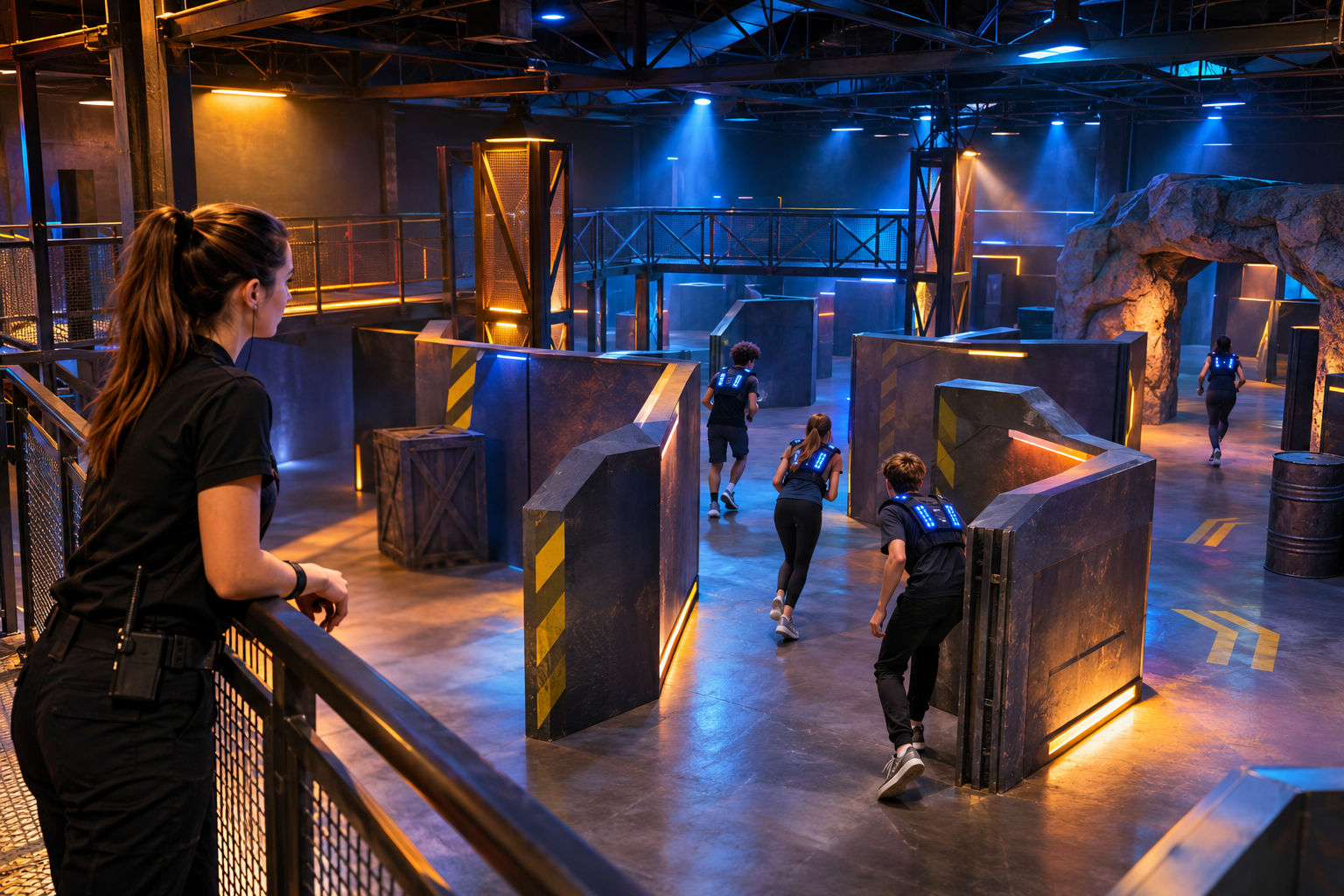
Start a fixed indoor laser tag arena design with the guest journey: arrival, waiting, briefing, equipment issue, play, equipment return, and departure. Then add staff routes for equipment checks, cleaning according to the manufacturer's instructions, and preparation for the next group. This plan can reveal where guests and staff might get in each other's way before decorative structures are installed.
Map the complete player journey
Mark the group assembly point, briefing space, equipment issue and return points, and the maze entrance and exit. Walk the route with your team. Check whether players can hear the instructor during the briefing and where early arrivals will wait. Rehearse the moment when one group returns its equipment while the next gets ready to play.
The official CYBERTAG arena design page identifies a play area, entrance area, instructor's room, reception, and waiting area. These provide a useful starting point for a design brief. Select and size the zones for your own premises and operating format.
Plan the instructor's work
For each stage, record the staff task: explaining rules, helping players fit equipment, checking connections, starting a scenario, monitoring play, or collecting equipment after a round. Assign responsibility when groups are large or staff work in shifts. Keep working spares separate from devices awaiting inspection and identify both in your inventory.
The control system should support those tasks. Ask the supplier to demonstrate team assignment, game start and finish, device status messages, and final statistics. The official CYBERTAG FAQ describes its scenario editor, statistics, and end-of-round signals. Check these functions on the specific software version and equipment included in your quotation.
Rehearse the changeover between groups
Ask for a demonstration with your intended group size and a route that reflects your premises. Run the complete cycle: assembly, briefing, equipment issue, play, return, and preparation for the next session. Time each stage and record delays: who needed assistance, where a queue formed, and which settings staff had to change manually.
Use the rehearsal to adjust the equipment counter, waiting space, and staff responsibilities. The number of kits, sensors, or scenarios in a marketing description does not by itself determine venue throughput. Assess capacity through the actual operation of your chosen site and team.
Confirm evacuation and fire-safety requirements for the specific premises with qualified local professionals and the relevant authorities. This article's artistic cover is not a construction or safety plan.
Disclosure. TRUTNEE is affiliated with LASERWAR. Information about the design service and CYBERTAG features comes from the manufacturer's primary materials, checked on November 14, 2026. The operating recommendations are an editorial checklist; agree on equipment configurations and project terms separately. This guide is not tied to a specific event.
Comments
To leave a comment, you need to log in. (log in / register)