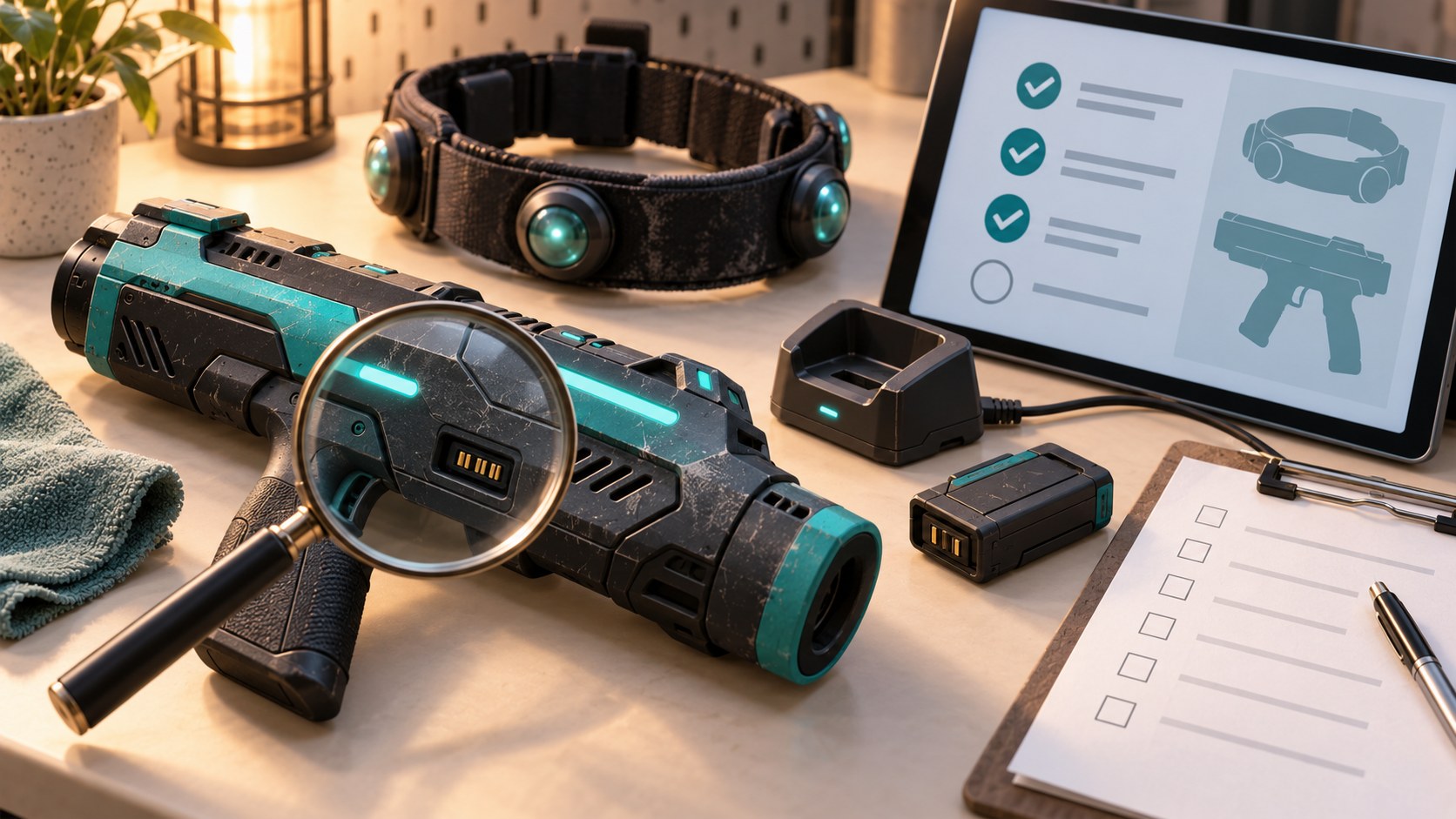
A listing makes it easy to compare a tagger count and asking price. An operator needs to know how many complete sets can run a session, what must be replaced and who can support the system after purchase. Use this checklist to organize inspection and handover.
1. Identify the complete bundle and its history
Request an inventory with model names, generations and serial numbers where available. List sensors, vests or headbands, controllers, base stations, chargers, cables, cases and game devices separately. Ask which objects in the photos are excluded from the sale.
- Who is selling, and what documents establish their ability to transfer the equipment?
- Where and how was the system used?
- Which units have been repaired or had batteries or electronics replaced?
- What is faulty, untested or due for service?
- Which manuals, software rights and accessories are included?
Record the distinction between a seller's statement and evidence you have checked. A company's online presence or a forum account does not establish the condition of a particular bundle. Request clear terms for the actual equipment you are considering.
2. Test every set through a complete game cycle
A power-on video verifies little beyond power-on. Agree on a repeatable test: configure the units, start a session, register shots and hits, end the game, retrieve results, reset and start again. Track deviations by unit rather than by a general description of the bundle.
| Area | Inspect or demonstrate | Record |
|---|---|---|
| Cases and attachments | Cracks, loose fittings, connectors, straps and repair traces | Defect photos for identified units |
| Game electronics | Controls, audio, indicators, sensors and event registration | Results from the same test for every unit |
| Power and charging | Approved chargers, charged operation and unexpected shutdowns | Test conditions and observed operating time |
| Management and reports | Group configuration, communications, reset and results | Software versions and a complete workflow recording |
Use conditions relevant to your format: light levels, site layout and simultaneous devices. A range or battery-life claim for a different model is not a measured result for the used units in front of you. Have a qualified service provider inspect anything you cannot reasonably assess.
Inspect batteries and chargers without opening or modifying them. Damage, deformation or unusual heat should stop use pending qualified assessment. Follow the instructions for the exact model, including approved charging components; this article does not provide a battery repair procedure.
3. Confirm compatibility and software transfer rights
A shared brand name or similar-looking case does not establish compatibility. Send the manufacturer or authorized support provider a list of models, generations, firmware and software versions. Ask for written confirmation of the intended mixed configuration and then demonstrate it.
Questions for the software and support provider
- Which units can play together, and which functions are limited?
- Can the license and installation rights transfer to the buyer?
- Is a new activation, subscription or update required?
- What computer, network and control equipment is needed?
- How is the previous owner's access removed through the supported process?
- Who supports configuration, updates and recovery after handover?
Receiving a personal account password is not evidence that a license has transferred. Check the actual software terms and the provider's transfer process. Manufacturer programs can also be model-specific: LASERWAR's published trade-in information describes its program, not a universal rule for used gear. Confirm current eligibility and terms directly rather than assuming a bundle qualifies.
4. Compare the cost of a ready-to-use system
Add the bundle price, shipping, inspection, necessary repairs, missing chargers or control devices, software activation and replacement components. Request estimates from the people who will perform the work. Keep unresolved costs visible rather than treating them as zero.
For a US buyer, confirm who ships the equipment, who handles any import process, and which power-supply and charging components are approved for the destination. Obtain delivered-cost and responsibility information for the actual shipment; a foreign listing price is not a complete US quote.
Compare the used bundle with a new configuration that performs the same job over the same planning period. A lower asking price may be unhelpful if the software cannot transfer or repair is unavailable. Ask where repairs happen, how parts are sourced and who pays transport while a unit is out of service. The support and warranty checklist and equipment comparison hub provide related questions.
5. Agree on inspection and handover before payment
Specify where testing takes place, who attends and which results you expect. For a shipped bundle, agree on packing, inventory confirmation and the process for damage or discrepancies. Keep correspondence, test records and the inventory together.
- Match delivered units and accessories to the agreed list.
- Repeat the game-cycle test on the accepted bundle.
- Record defects, limitations and agreed corrective actions.
- Receive documentation and confirmation of software transfer.
- Prepare settings, maintenance and a service reserve for your venue.
Payment, return and warranty arrangements depend on the particular transaction and agreement. Resolve those terms before transferring money. This checklist organizes due diligence; it does not certify a seller or individual listing.
Common questions about used laser tag equipment
Is a seller's video enough?
Request a full game-cycle video identifying the units, but recognize what it cannot show. For a substantial bundle, consider on-site inspection or an agreed service assessment.
Can old and new equipment work together?
Confirm the exact models, generations and software, then test combined play, management and results. A single exchanged signal is not a complete compatibility demonstration.
Are the cards below current offers?
The cards in this demonstration section are labeled samples. They do not establish current availability, pricing or condition. Check the date and terms of an actual listing with its seller.
What about the old equipment directory?
The older equipment directory retains legacy listings. Their historical dates and prices do not establish a current offer. This page is the current buyer guide; inspect a live sale separately.
Sources and disclosure
LASERWAR's manufacturer trade-in information, checked October 11, 2026. Model-specific details and software rights require confirmation from the applicable provider. The checklist is an editorial inspection framework, not a technical report on a specific bundle.
TRUTNEE is affiliated with LASERWAR. This is not an independent product test. The AI-generated illustration is conceptual and does not depict an actual sale item. For launch planning, read the US laser tag business guide.