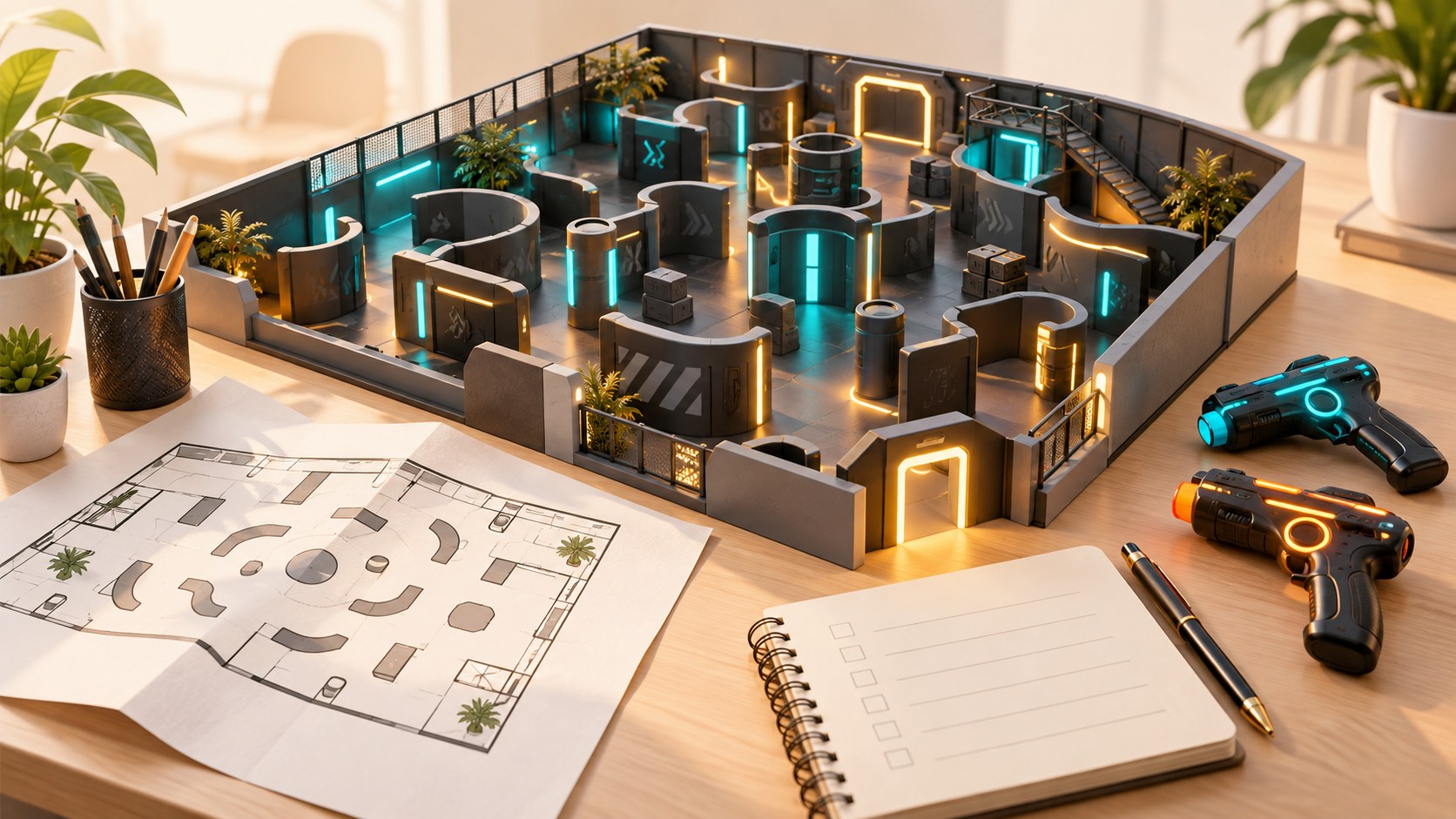
A laser tag venue sells an organized experience: easy booking, a clear briefing, understandable rules, working equipment and a well-run game. The equipment alone does not solve questions about the premises, schedule or attracting customers. This guide sets out practical decisions and checks to make before opening.
1. Choose a format and a first customer segment
Start with one audience: families planning birthday parties, corporate groups, schools or recurring players. Ask people in that audience what matters to them. Families may value simple booking and a place for the group to gather; corporate organizers may need a reliable schedule, convenient access and a clear group booking process. Treat these as assumptions until you test them in conversations and inquiries.
| Format | Operating setup | Validate before committing |
|---|---|---|
| Indoor arena | Maze, briefing area, equipment issue and charging space | Guest flow, building suitability and the lease |
| Outdoor field | Approved site, barriers, storage and a weather policy | Site access, transport and seasonal demand |
| Mobile events | Vehicle, protective cases, portable setup and an event crew | Travel, loading, setup and reset time for the entire booking |
| Family entertainment center add-on | Integration with existing attractions and party bookings | Shared staffing, floor space and scheduling conflicts |
Map the alternatives customers can actually reach: laser tag venues, mobile providers and other group attractions. Record publicly available packages with the date checked. A directory entry does not establish a competitor's attendance or revenue. Use your research to identify a specific customer need, then review the business format guide.
2. Assess the location before signing commitments
Evaluate the whole guest journey, rather than the arena floor alone. Plan check-in, briefing, equipment issue, play, results and the next group arriving. On a floor plan, trace both an incoming and an outgoing party. Any crossing point needs an operating solution.
- Discuss the proposed use with the landlord and the relevant local authorities.
- Check access, restrooms, electrical supply, connectivity and back-of-house storage.
- Have qualified local professionals assess building, occupancy, accessibility and fire-safety requirements for the actual premises.
- Document responsibility for build-out, maintenance and restoring the space.
- For mobile events, agree on site access and cancellation or weather arrangements.
The SBA launch guide explains that licenses and permits depend on activities, location and government rules. Check the relevant state, county and city requirements. Your business structure, registration, insurance and tax arrangements should be reviewed for your particular operation; there is no nationwide approval checklist supplied by this article.
3. Build a budget from documented costs
Split the budget into one-time setup costs and recurring operating expenses. This follows the general approach in the SBA planning resources. For a laser tag operation, make each quote comparable: quantities, included software, delivery, setup, training and ongoing charges.
| Setup | Operations | Evidence to obtain |
|---|---|---|
| Game equipment, shipping and commissioning | Subscriptions, maintenance and replacement parts | Itemized supplier quote, exclusions and renewal terms |
| Build-out, barriers, cases and furnishings | Rent, utilities, storage and transport | Lease terms and contractor estimates |
| Training, booking website and launch materials | Staffing, marketing and payment processing | Staff schedule and service provider proposals |
Keep dates and currencies with every estimate. A foreign equipment price is not automatically a delivered US cost: ask the supplier and shipping provider to identify any additional charges and responsibilities. Do not fill gaps with a competitor's promotional earnings claim.
Separate weekday and weekend demand, private parties and open-play sessions. Prepare cautious, working and stronger-demand scenarios, each with explicit assumptions. Calculate how many bookings would cover the operating costs in your own model. An arena that fits a large group on paper may still need time for check-in, briefing, cleaning and reset. A model is a planning tool, not a guarantee of profit. Keep the assumptions and source documents in a business plan for your own project.
4. Compare complete systems under the same brief
Give every supplier the same brief: indoor, outdoor or mobile format; your floor plan; expected group size; game-management needs; and service requirements in your area. Compare complete systems with the same scope; do not compare the price of one tagger with a turnkey offer.
- Inventory: list each item separately, including taggers, sensors or vests, chargers, software and game-control equipment.
- Demonstration: watch setup, game start and reset. Ask to see a device replacement and a sample report.
- Compatibility: confirm exact models, generations, firmware and software, especially when adding used equipment.
- Support: get warranty, repair, update and spare-parts terms in writing, including how to arrange service in your area.
- Acceptance: agree on what to test after delivery and how to document any defects.
Ask where repairs are handled, which shipping costs you would pay and what happens while a unit is away for service. A claim of worldwide support does not explain the process for your location. Use the comparison hub and buyer checklist to organize questions.
5. Run a pilot of the full booking cycle
Test the operation before promoting a full schedule. Trace the guest journey from the first inquiry and booking confirmation through arrival, briefing, equipment issue, play, results and group changeover. Assign a person to each step. Practise what staff should do if a device fails or a group arrives late.
Before the first paid session
- Clear booking, cancellation and rescheduling information.
- Documented staff procedures and a checked equipment inventory.
- A briefing script and a site-specific operating plan.
- A charging, cleaning and equipment replacement routine.
- A record of actual changeover times and recurring delays.
- Support contacts and an unresolved-issues list.
Adjust capacity and scheduling using observations from the pilot. Track inquiries, bookings, completed sessions and returning customers as separate measures. Expand equipment when actual bookings justify the change. If used gear is part of that plan, follow the used equipment inspection guide before agreeing to a bundle.
Common questions about starting a laser tag business
How many sets do I need?
Choose the quantity from the validated group size, session format, schedule and maintenance reserve. Confirm the configuration with the supplier and test it in the pilot. A universal equipment count without those inputs is not a reliable answer.
Do I need a franchise?
Compare a franchise offer with buying direct. Check what support is included, what brand rights you receive, recurring fees, operating restrictions and exit terms. A franchise label does not prove demand or guarantee a financial result.
Can I launch with used equipment?
Check the condition of the complete system, whether it can be repaired, whether it is compatible with your setup and whether software rights can be transferred. A listing price alone does not show the cost of delivery, repairs or setup.
Sources and editorial scope
General US planning and launch guidance: SBA: Plan your business and SBA: Launch your business, checked October 12, 2026. The laser tag workflow and checklists are TRUTNEE's editorial planning framework, not measured market demand or an independent equipment test.
TRUTNEE is affiliated with LASERWAR. The criteria apply to any supplier. The AI-generated illustration is conceptual and does not depict an actual venue.